For decades, the automotive customer journey was predictable: you bought the car, drove it off the lot, and the manufacturer or dealer didn't hear from you until your first oil change. But with electric vehicles (EVs), the rules of engagement are fundamentally changing.
From installing home infrastructure to navigating "range anxiety" and real-time charging data, EV owners aren't just buying a new car, they’re learning a new lifestyle. To meet their needs, ease their uncertainty, and foster loyalty, brands must shift from a reactive “gas mentality” to a proactive customer experience (CX).
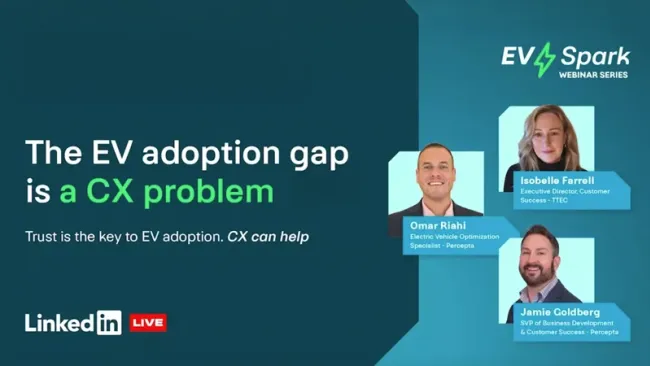
Experts from Percepta explored how brands can meet the moment and best serve EV owners in the recent EV Spark webinar, “Build customer confidence with proactive CX guidance.”
EV ownership starts before the sale
The EV customer journey is different from traditional car buyers’, said James Goldberg, Percepta’s senior vice president of customer success. Trying to shoehorn their experience into a more traditional, gas-powered car buyer’s journey won’t work.
With EVs, he noted, “the actual ownership starts before the purchase.” Customers must invest in infrastructure and install chargers at their homes before they ever drive the car off the lot.
The entire process can feel overwhelming for buyers. They have to learn a new way of doing something they’ve been doing for years: they’ll have questions finding and using public charging stations, managing car repairs, and navigating their vehicle’s features.
“EV vehicles are also very connected,” Goldberg said. “They’re very data-rich and feature-rich, but confidence-poor for customers because they’re not sure what this is.”
Proactive support for the long haul
To deliver a seamless experience, brands need to preemptively predict customer needs and questions.
“Proactive onboarding is essential to the EV ownership experience,” said Omar Riahi, Percepta’s global EV optimization specialist. Dealers can only impart so much information at the point of sale before customers become overwhelmed, so it’s important to reach out to customers during the first several days they have the car at home.
Contacting customers to provide guided onboarding, welcome calls, and virtual vehicle tours in those early days goes a long way in building trust and loyalty, Riahi said. Brands should also walk buyers through how to locate chargers, tell whether chargers are online or out of service, and efficiently plan travel routes.
But proactive outreach needs to continue throughout the customer journey, too, said Pete Rodriguez, Percepta’s director of operational excellence. Customer support shouldn’t only happen when buyers encounter issues.
Vehicle health alerts can comb a car’s data and can trigger support before a customer even knows there is a problem. With real-time data, brands can proactively alert customers about a needed oil change or a tire leak, for instance. This helps customers feel like the brand is still with them even after the sale.
“When these touchpoints are in place, we see a clear benefit,” Rodriguez said. In addition to providing better CX, these types of alerts and interventions lead to fewer inbound support calls, faster resolutions, fewer escalations, and higher customer satisfaction.
From uncertainty to understanding
Anxiety is a real part of many EV buyers’ journeys, and Riahi said it typically manifests in two forms: range anxiety over whether a car will have enough range to get to the next charger, and charger anxiety over whether a charger will work when a driver gets to it.
Brands can serve a critical role here too, by educating customers beforehand and walking them through what a typical charging experience looks like.
“When customers don’t know what to expect, every fluctuation becomes a concern,” Rodriguez said. “Once a customer understands what’s normal, and knows that someone’s watching out for them, anxiety tends to drop dramatically.”
There are other ways brands can ease anxiety as well. Navigating among an OEM’s app, a charger’s app, and potentially a third-party app intended to meld the two can produce a clunky customer experience, Goldberg said. Anything brands can do to make that process more seamless will significantly improve CX.
A long-term blueprint for EV loyalty
The secret to a successful EV transition isn't found in a single "wow" moment at the dealership, but in the steady, reliable support that follows a driver home.
“It’s about consistency over time,” Rodriguez said.
Brands can foster greater loyalty by having a thoughtful onboarding process, helping customers master the features of their car through guided tours, and offering ongoing reassurance throughout the relationship.
“When those layers work together, customers don’t feel like they’re figuring out those things alone,” Rodriguez said. “Stop assuming customers will figure it out on their own. Stop waiting for complaints before engaging.”
To hear the whole conversation, check out the on-demand webinar, “EV spark: Build customer confidence with proactive CX guidance.”