“AI is going to transform customer experience (CX).”
This is what the industry keeps telling CX leaders.
Unfortunately, many of them are getting stuck at the same dead end: infrastructure made for a different era.
For contact centers built on decades of legacy infrastructure and custom integrations, the promise of AI has collided with architectural reality, creating a widening gap between what CX leaders are being asked to deliver and what their systems can realistically support.
Many customers now interact with AI-supported experiences on a daily basis, and those experiences are quickly leading to an expectation for the same efficient, self-service experiences everywhere and with everyone.
Meanwhile, the C-suite sees headlines about AI reducing costs and improving efficiency, and they expect their CX leaders to achieve the same results.
Here’s the complicated truth for CX leaders: replacing the mission-critical contact center systems that power millions of customer interactions can be expensive, disruptive, and risky.
As a result, many CX leaders feel trapped, forced to choose from the same two bad choices:
- Option #1: Bolt-on point solutions or build custom integrations that bring AI into their legacy environment, while placing the stack under even greater stress.
- Option #2: Commit to an expensive, time-consuming “rip and replace" of their core technology.
The reality is that the path to CX innovation does not have to be a “rip out” or “duct tape” situation.
There is an emerging option that allows organizations to embrace the future without abandoning the investments of the past, and that’s through a universal connector.
However, to see why this path is so critical, it helps to first examine the significant risks associated with both digital stagnation and the daunting prospect of a total technology overhaul.
The risks of digital stagnation
Choosing to maintain legacy contact center environments without a clear strategy for modern AI creates vulnerabilities that put organizations at a distinct financial and competitive disadvantage.
Organizations tethered to older, static stacks find themselves increasingly cut off from the latest tools for automation and customer engagement, making it nearly impossible to keep pace with competitors who can pivot in weeks rather than years.
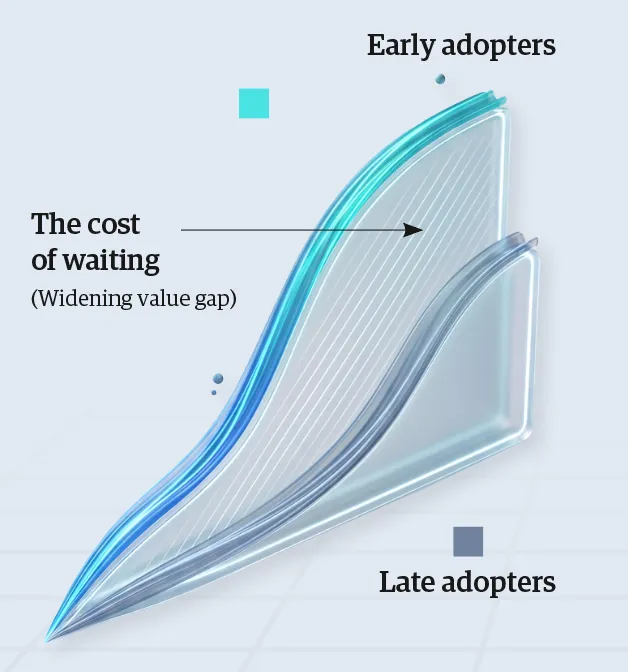
Late AI adopters fall further behind as early adopters build experience, data, and operating strength.
We’ve seen this before. When CX entered the cloud era years ago, many contact centers chose to create hybrid environments that combined on-premise and cloud technologies. For some contact centers, this was a strategic choice and part of the business’ future CX roadmap. For others, it seemed like the fastest path forward — and now they’re paying the price in slow innovation and costly maintenance.
This technical stagnation creates a financial drag on an organization’s bottom line. Legacy platforms can lock contact centers into higher cost-to-serve through longer handle times and limited self‑service options, which directly erode the customer experience. At the same time, they reduce a company’s ability to protect revenue — for example, by leveraging AI to spot customer churn early and respond with meaningful, personalized and proactive engagement.
As these systems age and reach "end-of-support" milestones, the lack of regular security patches and updates also increases the risk of system outages and operational instability.
This technical burden even impacts the employee experience. Rising contact center turnover is frequently linked to the difficulty agents face when juggling multiple, disconnected systems. This leads to slower onboarding times and higher costs per interaction.
Why "rip and replace" is a difficult pill to swallow
Conversely, many organizations have serious concerns about overhauling mission-critical systems, especially when they have spent decades building and customizing them.
These legacy environments are often deeply integrated into revenue-critical processes. A total replacement is not just a technology swap; it could be a fundamental disruption of the business. Such projects can also be prohibitively expensive and carry the risk of harming service levels during the transition.
Beyond the cost, there is the issue of institutional knowledge embedded in the code. Organizations have spent years fine-tuning specific workflows and compliance protocols that are unique to their brand. A "rip and replace" approach threatens to erase these customizations, forcing a choice between modern features and the unique operational logic that keeps the business running.
A third path: The power of universal connectors
There is a transformational path forward that nicely avoids the stagnation of legacy systems and the risk of a total overhaul. This third way utilizes open APIs and modern connector frameworks to create a flexible layer inside the existing CX ecosystem.
By using a connector-based approach, organizations can bring AI into current workflows without fully embedding or custom-coding it into the platform. This strategy helps avoid vendor lock-in and allows businesses to swap or upgrade AI capabilities without disrupting the entire tech stack.
More importantly, it lays a foundation for where AI-enabled CX innovation is headed next, which is tapping into different models and AI tools to accomplish different tasks — all managed in the same AI intelligence layer.
Designed specifically to create a central location for all AI capabilities to connect with legacy contact center infrastructure, a solution like AI Gateway acts as a universal connection layer between contact center environments and frontier AI solutions — essentially connecting any CCaaS platform with any AI solution.

The value of this approach is centered on flexibility. It allows businesses to deploy, test, and scale multiple AI tools within the ecosystems they already operate, rather than embarking on costly and extensive migrations to integrate each one separately.
Balancing ambition with reality
The path forward requires a shift from maintaining infrastructure to driving outcomes. By utilizing an AI intelligence layer-based strategy, businesses can begin deploying high-impact AI use cases immediately. This approach allows organizations to satisfy current business demands for innovation while preserving the flexibility to mix or swap AI capabilities as the market evolves.
Instead of being locked into a single version of the future, companies gain the ability to test, learn, and scale in real time. This transforms the contact center from a static infrastructure cost into a resilient, high-performing asset that adapts as quickly as the AI landscape itself.