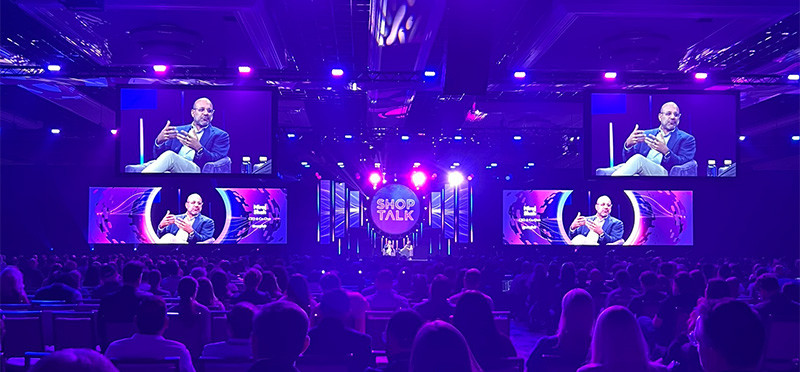
A new term is circulating the retail industry: a-commerce. Short for agentic commerce, it was mentioned repeatedly by Shoptalk Head of Content & Insights Joe Laszlo during his recent conference session on retail predictions.
The name tracks – during the Shoptalk annual retail conference earlier this spring, agentic AI was everywhere. Nearly every session and exhibit hall booth incorporated AI in some way.
The mood reflected consumer behavior – shoppers are increasingly using AI, though not for a complete shopping experience, experts cautioned at the show.
“We believe agentic commerce is real, will scale, and lead to e-commerce taking a big share of retail,” said Ben Miller, Shoptalk vice president of original content and session co-presenter. Both Laszlo and Miller pointed to a Merkle study that showed shoppers who regularly use AI jumped by 11% in just four months, to 26% in February.
Earlier in the show, Merkle Global Chief Strategy Officer Holden Bale explained that the research uncovered that AI is used primarily in the discovery and recommendation phase of the shopping journey today, not the actual transaction.
“Agentic commerce does not exist yet,” said Bale, but “AI shopping companions are accelerating rapidly.” AI is showing up in product discovery and evaluation, if not yet hosting the actual purchase, he said. But with new AI enhancements being rolled out, including a partnership between Google and Shopify for Shopify Agentic Storefrontsand OpenAI’s shopping assistant, merchants are starting to sell directly through AI assistant apps like Google Gemini and ChatGPT.
In a December research report, Morgan Stanley predicted that agentic shoppers could account for up to $385 billion in U.S. e-commerce spending by 2030, capturing 10% to 20% of market share. Purchases involving AI are most common in groceries and consumer packaged goods, the report stated, which is where many brands and technology firms are focusing efforts.
There is great opportunity to use chatbots and AI assistants to make product recommendations and help decision-making, but only if consumers trust them, said Sky Canaves, eMarketer Principal Analyst for Retail and Ecommerce during the event. She shared research that said only one-third of shoppers say AI has helped them shop faster, and two-thirds of consumers perceive bias in AI-generated product recommendations.
“Retailers need to invest in resources to build trust,” she said. User ratings, expert testimonials, influencer partnerships, and other activities can help build confidence that recommendations are not biased.
AI search means goodbye brands, hello products
AI-infused retail also shines the spotlight on AI-powered search. “AI will eat search and some marketplaces,” Merkle’s Bale said.
For example, the crowdsource social platform Reddit has emerged as a leading source for AI knowledge, according to Leslie Ann Hall, founder and CEO of Iced Media. YouTube, Wikipedia, and others are not far behind. There, individual reviews become sources for AI recommendations, rather than paid ads or owned media. As a result, brand reputation becomes less important as AI scours all types of sources to find what products meet customer needs.
“Agentic commerce will democratize brands because AI won’t automatically recommend big brands with a lot of site traffic,” Shoptalk’s Laszlo said.
“Loyalty used to matter, but it’s waning,” added Chag Lusk of management consulting firm Alvarez & Marsal. “Customers care less about the name on the label than the attributes of your product.”
This means the old rules of search engine optimization and brand awareness don’t matter as much, Hall said. Search engine optimization is being replaced by AI through strategic Generative Engine Optimization (GEO) and tactical Answer Engine Optimization (AEO), she said.
Hall’s advice? “Make sure AI can access and understand your content.” That includes your own channels, but also information about your brand on third-party sites.
Echoing that sentiment, Kimberly Shenk, co-founder and CEO of AI recommendation platform Novi Connect, highlighted three challenges retail brands are facing related to AI-powered retail:
1. AI doesn’t see me
2. AI sees me, but doesn’t represent me correctly
3. AI recommends my products, but not in the right way
Shenk recommended retailers create robust descriptions and deep attributes in their catalogs and on their sites to make sure they’re discovered by AI.
COS gets focused on a clear message
Fashion brand COS recently ranked at the top of a recent pulse survey on AI discovery from media publication Business of Fashion.
At the show, Lauren Price, senior vice president of marketing at COS, said the accolade is based on a clear focus on specific topics, not general merchandise. She said the company developed a “clear brand message that AI can communicate” that’s not nuanced. The team made sure communications across channels were clear and consistent.
For example, Price said they focused on cashmere and “hammered home what makes the brand strong in that category,” rather than talk about all their products.
“ChatGPT is dominant LLM for fashion and beauty,” Price said. “Use a clear brand identity” to show up in that channel, she added.
Retail’s next act: More brands, more personalization
In their session, Shoptalk’s Laszlo and Miller also predicted a boom of new retailers and brands, similar to the dot com boom. Right now, Amazon, Walmart, and Costco control the lion’s share of retail, but those days may be numbered.
“AI enables non-experts to build digital stores and get nimble entrepreneurs to market quicker,” Laszlo said. Fewer barriers to market mean more competition and more innovation. They said they are excited to see what new retailers will emerge with innovative products and customer experiences.
And of course, don’t count out people. Physical stores will get to know shoppers personally and new loyalty programs will be built on large amounts of data that can be managed at scale by AI.
Christine Barone, CEO of Dutch Bros. Coffee, told the audience that while the company has grown to be the third-largest coffee chain in the U.S., its success hinges on personalization and its unique culture.
“It’s really hard to scale service,” she said. “How can you keep the feel of that first shop as you expand?”
It helps that the chain allows customers to customize their made-to-order drinks and that the brand is about positive energy. As a result, customers feel connected to the brand.
“We’re a brand for everyone. What resonates is that service piece and being seen,” Barone said.