Electric vehicle (EV) interest is everywhere, but conversion is not. There’s a lingering gap between curiosity and action, and one thing’s becoming clear: technology is no longer the bottleneck; customer experience (CX) is.
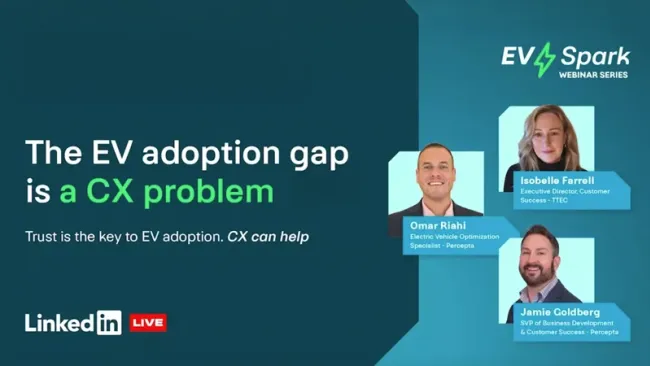
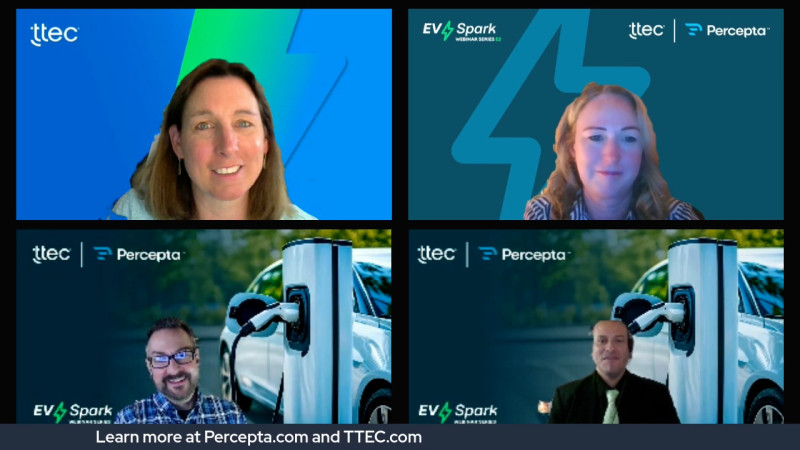
Experts from TTEC and Percepta dove into this topic during the recent webinar, “The EV adoption gap is a CX problem.” Jamie Goldberg, Percepta’s senior vice president of business development and customer success; Omar Riahi, Percepta’s electric vehicle optimization specialist; and Isobelle Farrell, TTEC’s executive director of customer success broke down what’s preventing some consumers from taking the EV leap.
The barriers are real, and regional
Adoption friction looks different depending on where you sit. In Europe, for instance, 60% of public charging facilities are concentrated in just three countries — a stark infrastructure imbalance that leaves many would-be buyers without the confidence to make the switch, said Farrell.
“Unless you’re lucky enough to be in the Netherlands, France, or Germany, it’s going to be very difficult for you,” she said. “Particularly if you’re living in a European city where apartment or flat living is more prevalent, having access to public charging is again going to be really difficult for you.”
Ease of charging is a big piece of the puzzle in the United States as well, said Riahi.
“We’ve been working on solutions within Percepta specifically around helping at that point of charging, because a lot of things can go wrong when you’re plugging in,” he said. “And that becomes a barrier for people. If they feel they can’t reliably charge as easily as they could go to a gas station, they’re not going to be as happy.”
Convincing a customer to adopt an EV means asking them to learn an entirely new fueling process and fuel type. That's a CX challenge as much as an engineering one.
Answer the hard questions before the drive home
Much of buyers’ hesitation is built on persistent myths: that EVs don't work in the cold, that the battery will inevitably need replacing, and that batteries end up in landfills. The point of sale is where those myths live or die, so sales consultants must be ready to answer practical questions.
“This is where CX is imperative,” said Riahi. “At the point of sale, the sales consultants have to answer the hard questions: How do I charge this every day? What type of charger do I need? How do I find charging?” And if you can support and answer these questions and set customer expectations at the point of sale, they (customers) have a wonderful ownership experience afterwards.”
Goldberg agreed: “‘What is it going to be like to own this? What am I going to feel? I have range anxiety; help me get through that.’ Those kinds of conversations have to happen at the dealership,” he said.
Dealerships should provide customers with accurate information upfront and teach them how to get help when they need it.
Fleet adoption and road ahead
The discussion expanded beyond retail. Fleet adoption brings its own dynamics, such as depot charging, grid setup, and a "captive audience" of drivers who didn't choose the vehicle.
But it also unlocks possibilities gas vehicles can't offer: managed charging to avoid peak rates, vehicle-to-building power during outages, and even electrified municipal fleets doubling as emergency power sources.
The next wave, including vehicle-to-grid technology, will position EVs as not just transportation but as energy assets, Riahi said.
Simplifying a complex ownership journey
The EV ownership journey is more fragmented and complex than anything internal-combustion buyers have faced, and someone has to own it end to end, panelists said.
They described a journey stitched together among the vehicle, charger, apps, subscriptions, and utilities, making EV ownership far more complex than the traditional vehicle-OEM-dealer relationship. Farrell experienced that firsthand. Although she researched her first EV purchase, downloaded the vehicle app, and mapped out her first charging stop before a long trip, the charging station wasn't compatible with the app she had prepared.
"That could have been alleviated if I just knew what to expect and I was prepared," she said. "It would have been a completely different experience."
Experiences like Farrell's are exactly why panelists argued that the ownership journey can't be left to customers to navigate on their own. The best OEMs are assigning a single owner to the first 90 days of onboarding and making proactive welcome outreach a standard part of the handoff.
“The onboarding journey of your ownership has to be owned by one owner, and the OEMs that are embracing that are the people that are doing it right,” Goldberg said.
Two things in particular can help make the customer journey smoother, panelists agreed: tell customers where to find help – a phone number, chatbot, in-vehicle app – and sign them up in the vehicle’s app before they ever leave the dealership.
To hear the full discussion, watch the entire webinar on demand.