If one thing became clear in 2026 it’s that, despite significant investment in AI, many organizations are still struggling to realize meaningful business value. Brands have learned that deploying AI is very different than integrating it in ways that reduce friction, deepen customer relationships, and drive outcomes.
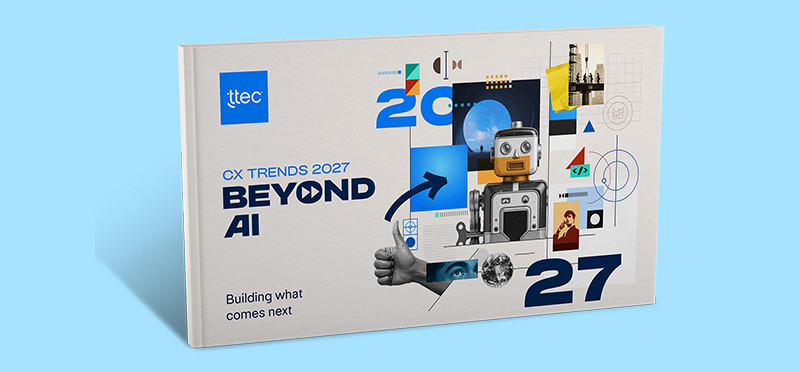
That gap between AI adoption and AI maturity is emerging as a defining competitive divide, and it’s a major theme of TTEC’s 2027 CX Trends report.
The next phase of transformation isn’t about deploying more tools. In 2027, savvy brands will move beyond AI experimentation and focus on AI orchestration. They’ll embed intelligence into the flow of work, address friction at its source, and deliver experiences that feel connected rather than fragmented.
Here are some of the market insights informing the CX trends we’re forecasting for 2027:
- 80% of organizations expect ROI from AI investments
- 66% of CX leaders reported net cost increases following AI adoption
- 60% of organizations will abandon AI projects unsupported by AI-ready data
- 68% of CX leaders believe supervisors and managers aren’t yet prepared to manage the next-generation associate
- 40% of agentic AI deployments are projected to be canceled, scaled back, or demoted by 2027 due to escalating operational costs, unclear business value, and inadequate risk controls
Automation stops answering and starts resolving
Answers are helpful, but resolutions create value.
For years, organizations have focused on deploying AI that can answer questions: customers ask a chatbot for information, associates seek guidance from a knowledge assistant, and the interaction ends when an answer is delivered.
But the next era of AI is about completing work, not just answering questions.
The industry is quickly moving beyond prescriptive AI toward autonomous agents capable of executing multi-step workflows, orchestrating actions across systems, and delivering outcomes with minimal human intervention. Moving into 2027, CX leaders should no longer be asking, "Can AI answer this?" but rather, "Can AI resolve this from beginning to end?"
That shift demands a new operating model. Autonomous agents won’t succeed if they’re just standalone tools layered onto fragmented processes. They need a connected ecosystem where AI, employees, workflows, data, and channels operate in sync around a shared objective. When orchestration replaces isolation, customers expend less effort, associates spend less time navigating complexity, and organizations achieve faster and more consistent outcomes.
As autonomous AI matures, experience orchestration will emerge as a critical competitive differentiator. The key will be to effectively coordinate people and technology to deliver seamless resolution at scale.
Optimize for outcomes, not for automation
The contact center industry has long treated automation as the ultimate measure of progress. Companies assume that the more interactions are automated, the greater the efficiency.
But leading organizations are beginning to realize that automation has a value ceiling.
Every brand reaches an optimal value horizon, an inflection point where additional automation generates diminishing returns. Beyond that horizon, the gains in efficiency are often offset by rising customer effort, reduced loyalty, or increased complexity elsewhere in the experience. The goal should be to automate where doing so creates the most value.
Some interactions should be resolved instantly through self-service. Others require human judgment, empathy, or complex problem-solving. Competitive advantage comes from knowing the difference and orchestrating the right AI-human blend in the right moments.
The brands that thrive in 2027 won't be those chasing 100% automation. They'll understand where automation adds value, where human connection matters, and how to seamlessly connect the two.
For more on this and the other trends we’re predicting will reshape CX in the year ahead, download our full CX Trends 2027 report, “Beyond AI: Building what comes next.”