Healthcare organizations have learned that significant investment in AI doesn’t automatically translate into meaningful business value. Many are embracing AI at a rapid pace but still working to bridge the gap between deploying intelligent technologies and using them to improve experiences, outcomes, and operational performance.
That gap is becoming more important as healthcare organizations face mounting pressure to do more with fewer resources while delivering better experiences for patients and members.
A technology decision doesn’t just affect efficiency. It can influence whether a patient gets the care they need without unnecessary delays, whether a member can easily understand their benefits, or whether a billing issue is resolved before it becomes a source of frustration and disengagement.
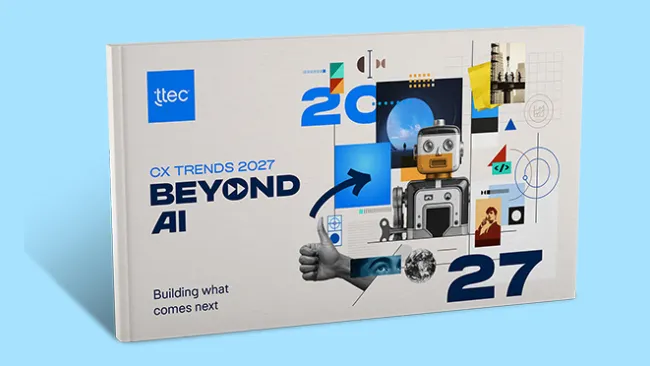
This challenge reflects a broader shift highlighted in TTEC's 2027 CX Trends report, “Beyond AI: Building what comes next.” Organizations are discovering that AI adoption and AI maturity aren’t the same thing. The next phase of transformation will be about orchestrating intelligence across people, workflows, data, and systems to create seamless outcomes – not just implementing more disjointed AI tools.
Healthcare is accelerating beyond AI experimentation
Recent research suggests healthcare is entering this next phase quickly. According to McKinsey, 50% of U.S. healthcare leaders reported implementing generative AI, while 19% had already implemented agentic AI. And 51% reported pursuing agentic AI proofs of concept.
The focus is increasingly shifting toward practical applications that improve operational performance. McKinsey found that healthcare leaders see the greatest value from generative AI and agentic AI in improving administrative efficiency.
At the same time, the 2025 CAQH Index estimated the healthcare industry could unlock an additional $21 billion in annual savings through greater automation of administrative transactions.
Those findings highlight that healthcare organizations are no longer asking whether AI belongs in their operations. Instead, they’re asking how to use it to eliminate friction, accelerate work, and improve experiences without sacrificing quality, compliance, or trust.
Automation stops answering and starts resolving
For years, healthcare organizations have focused on deploying AI that answers questions. Patients ask a chatbot about appointment availability, for instance, or members use it to look up benefit information. Providers use them to check claim status or contact center associates search knowledge bases for policy guidance.
Those capabilities can improve access to information, but they often leave the actual work unfinished. The patient still needs to book the appointment, the member still needs to resolve a coverage issue, the provider still needs to navigate multiple systems to determine why a claim was denied, and the associate still has to manually coordinate next steps across departments.
As we move into 2027, the next evolution of AI is about helping complete the work end to end, not just providing better answers.
Autonomous and agentic AI systems can support multi-step workflows that span departments and platforms. Rather than simply explaining a benefit, for instance, AI can guide a member through enrollment options, initiate required changes, verify eligibility, and schedule follow-up actions. Rather than showing claim information, AI can help identify exceptions, collect missing documentation, route issues to the right team, and proactively communicate status updates.
In this landscape, healthcare CX leaders should stop asking, "Can AI answer this question?" and start asking, "Can AI help resolve this need from beginning to end?"
The shift requires a fundamentally different operating model. AI can’t deliver seamless patient or member experiences if it sits on top of fragmented systems, disconnected workflows, and siloed data. Organizations need an ecosystem where AI, employees, clinical and administrative systems, workflows, and channels work together around a shared outcome.
When silos are broken down, patients repeat less information, members experience fewer handoffs, employees spend less time navigating systems, and organizations can deliver faster and more consistent resolutions.
Optimize for outcomes, not automation
Healthcare organizations have strong incentives to automate. Rising costs, workforce shortages, and growing administrative complexity make efficiency a strategic priority.
But automation isn’t the same thing as value. The industry's opportunity isn’t to automate every interaction; it’s to determine where automation improves outcomes and where human expertise remains essential.
Some interactions are highly transactional and benefit from maximum automation, such as checking claim status, processing eligibility verifications, updating demographic information, and scheduling routine appointments. They usually need little or no human intervention.
Other moments require empathy, judgment, or complex decision-making. A member appealing a coverage decision, a patient navigating a serious diagnosis, or a caregiver managing a complex billing dispute may need a knowledgeable person who can explain options, provide reassurance, and navigate nuance that AI alone simply can’t.
It will become important for organizations to define an "optimal value horizon" for each journey. This is the point where additional automation stops delivering meaningful benefits and starts creating friction instead.
To find that horizon, look beyond traditional operational metrics. Automation rates and containment percentages tell only part of the story. It’s also important to measure resolution, rework, member effort, patient satisfaction, complaint rates, employee confidence, and successful progression through key healthcare journeys.
The organizations that gain a competitive advantage will be those that know when AI should lead, when humans should lead, and how to make the transition between the two feel effortless.
Building the right AI-human blend for 2027
The healthcare organizations that thrive in the coming year will be the ones that resist the urge to pursue fully autonomous experiences at all costs and instead use AI to eliminate administrative burden, accelerate routine decisions, and free staff to focus on moments that require expertise, empathy, and personalized support.
AI’s greatest potential in 2027 lies in better resolution with less effort, stronger operational performance, and more consistent experiences across the healthcare journey.
For more on this and the other trends poised to reshape customer experience in the year ahead, download TTEC's full CX Trends 2027 report, “Beyond AI: Building What Comes Next.”