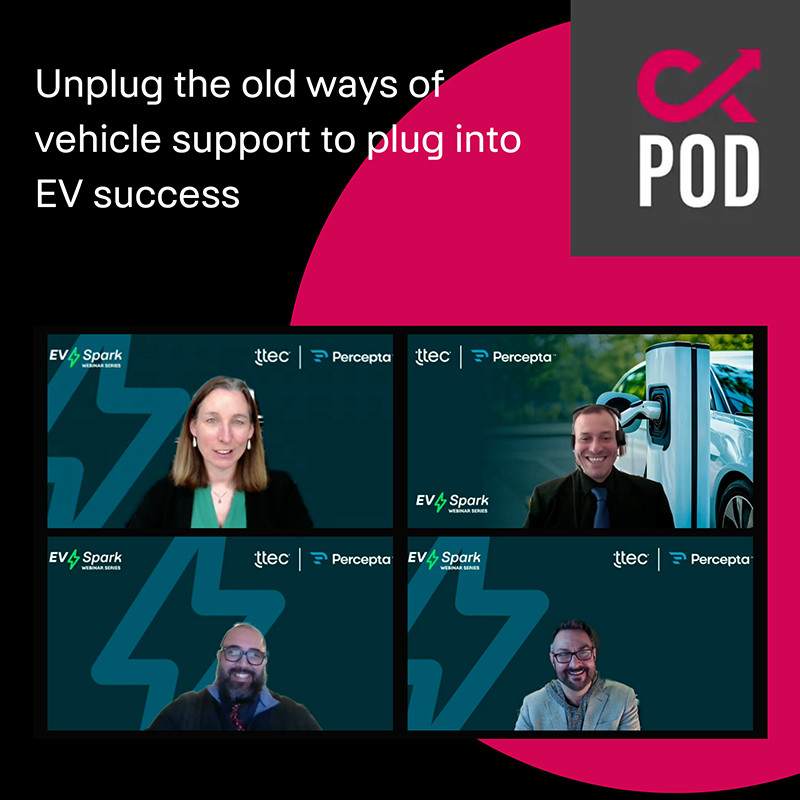
How can companies support new electric vehicle customers? In this LinkedIn Live excerpt, Percepta experts Pete Rodriguez, Jamie Goldberg, and Omar Riahi explain what brands should do first, and what they should stop doing to make the EV ownership experience great from day zero. Their consensus? A gas vehicle mentality will leave you stalled.
Want to hear more? Check out the full LinkedIn Live discussion.
Transcript:
Liz Glagowski:
You're listening to the CXPod from TTEC and the Customer Strategist Journal. Hey, everyone! This is Liz Glagowski of the Customer Strategist Journal. Welcome to the CX Pod. Today we're going to excerpt a recent LinkedIn Live conversation I had with some electric vehicle experts from Percepta.
I spoke with Pete Rodriguez, Jamie Goldberg, and Omar Riahi about how to create a proactive customer journey and really engage customers who might be new to the EV world and trying to navigate all the new, different, and unique ways that you need to think about ownership of an EV, of an electric vehicle. And we spoke specifically about what companies should start doing and should stop doing when it comes to being proactive with customers who are new to the EV journey. So take a listen and enjoy.
Liz Glagowski:
So we've talked a lot about so many different ways that companies can be proactive and really try to build that customer confidence. What should they do first? Or maybe what should they stop doing that maybe they're doing that has carried over from a ICE, a traditional vehicle? And then who do we want to start with this one? How about Pete? How about we start with you with this one?
Pete Rodriguez:
Absolutely. No, yeah. First, identify the biggest drivers of dissatisfaction early in the ownership stage. And we have to address those proactively, right? Especially in the first 30 to 60 days. Structured onboarding programs that we offer are often the fastest way to improve those outcomes. And just as important, absolutely stop assuming customers will figure it out on their own. An EV is a very complicated vehicle. There's a lot, and it's tied to a lot of data, right? So stop waiting for complaints before engaging. And stop applying traditional service models to what is fundamentally a new ownership experience.
Jamie Goldberg:
I will add to what you just said. I think you hit a nail on the head, Pete. There's one more place where the customers interact with the EV that is very important, and that is the app. So in most vehicles, the app is nice, I can do other things, but in EVs, it's remote start, it's climate control, it's all of these other things that you're doing from your phone.
That app experience has to be first and foremost, and if it's a fragmented experience and what I get in the dealer and what I get in the app and what I find on the web, that's a bad experience for the customer. So tying together that end-to-end journey, ideally what would happen is you'd use the data associated with the vehicle to tie into a predictive customer journey, and you would reach out to customers at the point when Pete said before service is needed, or before I have an onboarding question, because I have all the data, I can see what's happening. I can see when a customer is actually having difficulty.
So tying all that data into the actual actions that I'm taking and pulling that all together, being seamless in the app, the web, and on the phone is going to be foremost.
Omar Riahi:
And I would love to add to that, Liz, what companies should start doing first is they need to understand that this is a gasoline mentality. They need to stop applying traditional gasoline fuel business models to an EV. A customer, if I was one, I bought an EV and I was in the consumer position, I would, they need to discuss fueling, home charging, how to use the vehicle and set those customer expectations upfront so they understand.
Because assuming the customer is going to do it on their own is a terrible ownership experience.
And EVs, you have to discuss charging. You cannot buy an EV without reassuring the customer how they can charge and utilize that vehicle for their daily needs. That would be the first things they need to stop doing.
And #2 would be call us and hire us because we are the experts at this with 25 years of experience in CX. We understand this and we can assist your company or OEM, whichever, anybody.
Liz Glagowski:
Thanks for listening. Don't forget to subscribe to the CX Pod wherever you get your podcasts for more CX insights.