AI has officially moved from experimentation to ROI delivery. Rather than viewing AI as a futuristic concept or nice-to-have tool, companies are now seeing measurable business outcomes that directly impact their bottom line.
AI has shifted from enhancing personal productivity (which was exciting to people a few years ago) to driving actual business growth and organizations are no longer asking "Can AI do this?" but rather "How can AI scale this across our entire operation?"
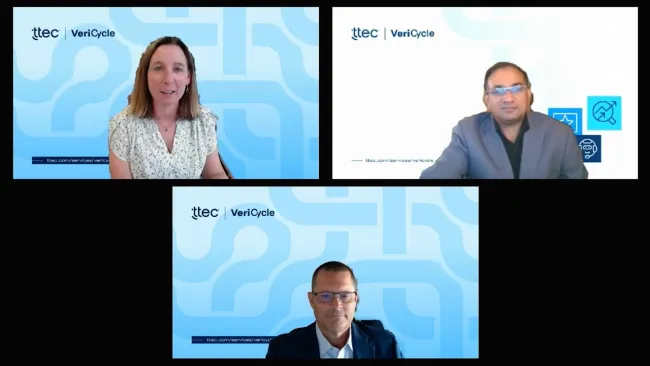
What does all this mean for sales teams? Holden Olsen, TTEC’s vice president of RevGen and Justin Coaxum, Microsoft’s technical sales director of AI business solutions dove into that topic during our recent webinar, “Find the light at the end of the funnel: How AI helps close revenue gaps from end to end.”
Break down silos with end-to-end customer views
One of the most significant opportunities AI brings is its ability to connect all the different stages of a customer's journey and remove the silos that typically exist between acquisition, onboarding, and support phases, Olsen said.
Creating a full account overview that captures all the key moments in the customer lifecycle has become essential for delivering personalized experiences and identifying revenue opportunities. Mining all of the data needed to provide a full end-to-end view of a customer is essential – and nearly impossible without AI, Olsen said.
In addition, large language models (LLMs) can review all customer contacts and identify areas of opportunity at scale, quickly surfacing gaps in training or agent skillsets that would take human teams weeks or months to discover.
Accelerate team proficiency with AI-powered coaching
AI is also making a huge impact on sales organizations when it comes to coaching and training.
"It has really accelerated how quickly you can bring teams to proficiency," said Olsen, noting how AI-powered programs offer immediate coaching based on realistic role-playing scenarios. “You can have as many (practice) conversations as you want now, before you ever have to talk to a client. Having that real-time feedback…is where AI is really taking off in the delivery space.”
Once they’re settled into their jobs, give sellers the continuous support they need through AI-powered agent assist flows, said Coaxum. AI can provide agents with nudges in the right direction to follow processes without being intrusive, he noted, and the approach helps maintain quality standards while empowering associates to handle more complex situations with confidence.
AI evolves from reactive tool to intelligent advisor
Customer expectations have evolved significantly. They no longer want to prompt AI with questions. Instead, "They want AI to prompt them on what they should be doing or what they should be thinking about or what they're missing," Coaxum said.
This proactive approach extends to sales as well, he said. AI is proving highly effective at scrubbing prospect lists for sales teams and even conducting autonomous first-touch outreach on sellers' behalf. This frees up human salespeople to focus their energy on building relationships and closing deals rather than manual prospecting tasks.
But it’s important to note, Coaxum said, the distinction between intelligent automation and artificial intelligence. AI has amazing capabilities, but organizations should resist the urge to overuse AI when regular automation can accomplish a task more efficiently and cost-effectively.
"Customers want to use AI for everything and sometimes good old-fashioned automation will work,” he said.
The Human-AI partnership
For all of AI’s benefits, the sales world still revolves around relationships, which means humans still play a crucial role.
“AI has a place and humans have a place, and they each have a superpower,” Coaxum said. AI boasts unparalleled, massive scale, and people excel at empathy and building relationships. Both are critical to sales teams’ success.
“The key to unlock is knowing the superpowers of both and where they fit and how they can work together,” he said.
From AI adoption to real business impact
As organizations continue to navigate their AI journeys, the message is clear: AI is no longer optional for companies that want to compete effectively. But success requires more than just implementing the latest technology. It demands a strategic approach that connects the entire customer journey, leverages AI where it truly adds value, and maintains the human touch that builds lasting relationships.
The light at the end of the funnel isn't just about closing more deals. It's about creating seamless, intelligent experiences that benefit customers and drive sustainable business growth.
For more insights, check out the full webinar on demand.