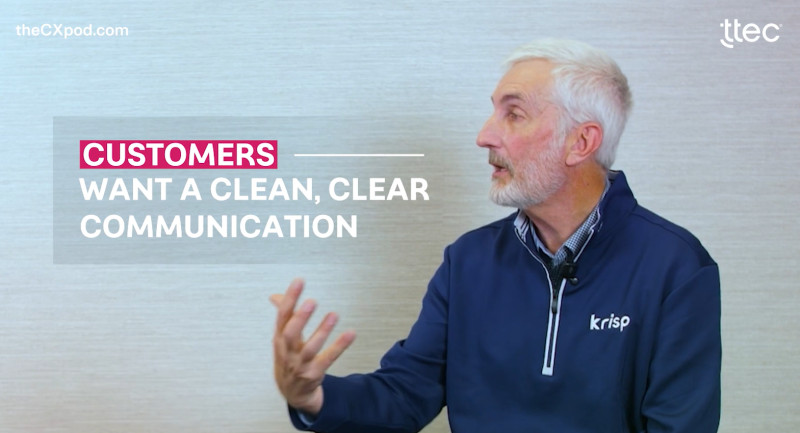
New tools and AI advances are changing how the voice channel works for customer experience interactions. Krisp's Robert Schoenfield discusses the impact of innovations around the voice channel for customers and businesses alike.
Transcript:
Hey, everyone. Welcome to the CX pod. I'm Liz Glagowski of the customer strategist journal. And today we've got another episode in our Tech Insights series. I'm pleased to welcome today Robert Schoenfeld of Krisp. Thanks so much for coming.
Thanks, Liz. Great to be here.
So you're the EVP of Licensing and Partnerships. Hi. And you've got a great insight. We do this series every so often with tech leaders about just key topics in CX, and I'd love to get your perspective today. Terrific. So Krisp uses advanced AI tools to improve real voice interactions, as well as using some agentic AI and virtual voice.
And then you partner with TTEC for its TTEC Clarity solution. So before we get into our deeper discussion, can you just give a quick intro about Krisp?
Sure thing, sure thing. We're a voice AI company.
We develop our own technology and apply it mostly to human agents, so helping the people doing the work today. If you think about agents in India, Philippines, here in the US, elsewhere, they have a couple of problems that customers complain about: noisy conditions, accents they can't understand, language barriers. So we apply AI for the call center agents to allow them to support customers with improved noise or, excuse me, improved voice clarity through reduction of noise, reduction or removal of the difficult parts of the accent, and then the ability to support a customer independent of which language they speak.
Yeah, that's great. I mean, its popularity really illustrates the staying power of voice, right, in real and virtual.
And I've actually seen the noise cancellation in action with a someone had a leaf blower Yeah.
And then just turned it on, and you couldn't hear the leaf blower anymore. I love that. Maybe for my kids, can do that So just what's your take on the power of voice in the customer experience and how it's still, you know, it's got that staying power?
Yeah. So if you think about the customer base, they range from people who are older, who really rely on voice communications, just because that's what they've traditionally been used to, and then you get into the younger demographic who grew up with mobile phones, and grew up with social media, and grew up with incident messaging, and so as I think about a company like TTEC, how do they support all of the above?
First things first is supporting their voice agents because when a customer calls in and they want to get a voice agent, they want to have a great experience, they really get frustrated when it doesn't go well. You can translate the same thing over to voice AI or agentic AI. If they have a clean communications, if they're not getting interrupted by the bot, and they get their resolution, they'll love that voice interaction. Any time they get false interrupted or the agent's going off in a different direction, causes friction, frustration, customer hits zero and says, Transfer me to a human. Then they get to a human, and again, they want to have that clean, clear communication so they can resolve their issue.
And it goes two ways, right? Because I know sometimes as a customer I'm calling in and maybe they can't hear me because I'm in the car or I'm in an airport or something like that, so the power to be able to eliminate those distractions to really focus on the interaction itself seems pretty powerful.
It really is, and we're unique in being able to have what we call inbound noise cancellation, so the customer, as you said, might be at an airport in a car, and that agent struggles and keeps saying, I'm sorry, can you repeat that? I'm sorry, can you repeat that? And of course, it creates frustration, CSAT problems, longer calls, all that, So the inbound is equally as important as the outbound.
When we think about accent technology, right now we're designed for the agent when serving North American and European customers.
India, Philippines, Africa, and Latin America. We're about to introduce what we call an accent understanding model, an inbound model, to help the agent understand thicker accent customers, so making accent bidirectional.
Yeah. So how ready are consumers to use They know they're using these enhancements, but also the voice AIs.
Are they more comfortable? Are they more wary? And maybe does it apply differently to different types of customers or different types of interactions?
Yeah, I think it's different for different demographics. Again, the younger customer, the more open they are to different communication mediums and different uses of AI.
For older generations, they may not feel comfortable if they get an announcement on the front and saying, Hey, we're using AI for this. But in reality, what we're seeing for agentic AI or voice AI agents is really working well on the front end for what I would call conversational IVR.
Think about it in the past, press one for this, do this, or you had to say a certain word, and customers were getting frustrated, hitting zero and saying agent, agent.
Now, with conversational IVR on the front end, able to speak naturally, it'll allow companies like TTEC to route it to AgenTeq AI or to a human based on that front end conversational IVR. So part of this is just getting people comfortable using the technology as it relates to employees or call center agents using voice AI to remove the difficult parts of their accent or support multilingual, we really thought that that would create a little bit of friction, and we're seeing just the opposite. We're seeing customers either not know, or when they hear it, they go, Oh, this is much better, and again, it translates to much better KPIs for the call center.
Yeah, that's going be my next question. The impact of voice enhancement, it may get better contact center metrics, but also then how does that translate to better business benefit and better customer experiences overall?
Yeah, so if you think about a contact center, it's got either customer support where people are calling in because they have a problem, or it's outbound and they're trying to sell something. So no matter what it is, the customer interaction, the customer satisfaction, NPS is really important, top of mind. Was that experience positive?
When you drop down one layer, you start to get into ROI based on the operation of the call center. So what was the average handle time? Was it reduced? And if it was reduced, by a couple points or by double digit?
Did their call get sorted out on the first call resolution?
Those are some of the key drivers, and what we're seeing across the board when CRISP technology is deployed literally from one day to the next, double digit improvements. Double digit improvements with CSAT. Average handle time goes down for call resolution. If it's outbound sales, their conversion rates improve by twenty to thirty percent.
Wow. Wow. That's great. So lots to be excited about.
Yeah, for sure.
Do you have one most exciting thing that you're looking forward to this year?
For this year, it really is the rollout at scale of Accent. It's being rolled out by the tens of thousands of seats weekly right now. We want to see this across the entire industry, and it makes sense. It's priced right, the functionality's right, the deployment model's right.
As we look to next year, we see two things. One is the broad scale adoption of voice translation, the ability to do live interpreter services instead of bringing in a third party. We've got that in the market now, and we see that accelerating. And then for us, so much of our work is focused on enterprises based in North America and Europe.
We're adding multilingual capability to our accent and additional multilingual capability to our voice translation so that independent of where the contact center is and independent of where the customer is, that contact center agent can serve that customer.
Right. So if we were to have this conversation next year, what would we be talking about?
Well, we'd be talking, I think, about two things. We would be looking at the adoption of AgenTic AI, so how much is that being used, and is there a reduction in headcount? That's going to be something that's going be ongoing for the next three to ten years.
But I really think it's going to be focused on the real use of AI, whether it's voice AI, gen AI, all of it, to make individuals' jobs easier so that they can do more and increase the quality of their interaction, and again, how much of these customer interactions can go to AgenTic? That's going to be the big question over the next couple of years.
Great. Well, good luck trying to make the most of it, and thanks so much for joining us today.
Thank you very much. Appreciate it.
All right. Thanks.