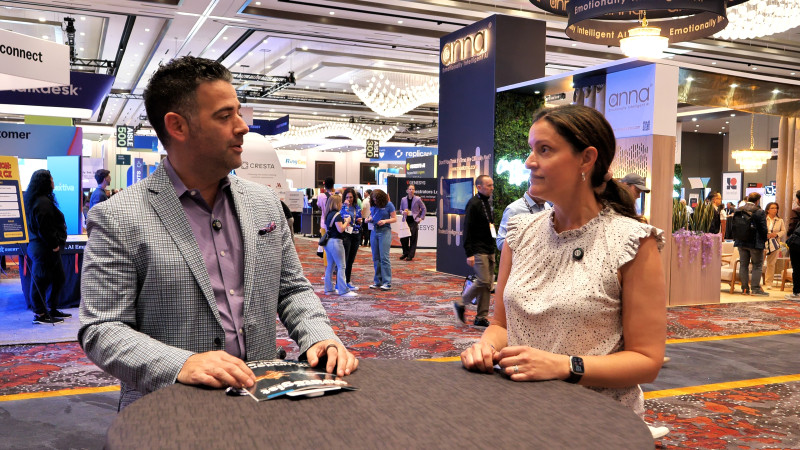
Recorded live at Customer Contact Week earlier this summer, Cara Rosner of the Customer Strategist Journal sits down with Andrew Santoro of Bank of America to discuss how a regulated industry leader balances brand reputation with innovation. They explore AI's impact on agent roles, the human-in-the-loop philosophy, and how Bank of America's Erica virtual assistant creates seamless handoffs between AI and associates to deliver a more personalized client experience.
TRANSCRIPT:
Cara Rosner: Welcome to the CXpod. I am Cara Rosner from the Customer Strategist Journal, and as you can see, we are here at CCW in Las Vegas. I'm excited to be talking to Andrew Santoro from Bank of America. Thanks so much for driving me. Appreciate it. Nice to meet you as well. So I wanted to talk a little bit about evolving customer expectations.
Bank of America obviously has been a giant in the financial services industry for a long time. You have a very storied and great reputation you need to uphold. You're also dealing with people's finances in a highly regulated industry. How at Think of America, do you balance the need for stability and keeping that brand reputation intact with wanting to innovate and evolve to meet changing customer expectations?
Andrew Santoro: That's a great question. I think, first and foremost, you have to inspire trust with our clients each and every single day. And like that brand and that reputation is extremely critical to ensure that we do that. But as you look at the evolving demographic, the evolving client experience, like we need to ensure that we're embracing that new technology, like really the ecosystem that we're operating in.
And how do we do that in a different way. And embracing that change and embracing AI is really critical to our future success. And how do we do that in a way in which that enables our clients, allows us to deliver a best in class client experience for them, but also enables our employees so that they could differentiate and really personalize that experience, to inspire that trust with their clients each and every step of the way.
Cara Rosner: Do you have any tips for other companies that might be in highly regulated industries? It may seem daunting to try to have this, you know, foster this culture of innovation. How have you managed to do it, and do you have any advice for other companies?
Andrew Santoro: I think that first and foremost, it's what you mentioned, the culture. So we got to establish a culture with our people and our associates to ensure that they feel comfortable really embracing change and trying new things and doing it in a way in which that is, really protects the client experience each and every single day, but is innovative.
So you got to give them the autonomy to innovate. But then also the safety blankets are where if it doesn't go the way in which that it needs to, you provide them that support and ensure that they have what they need to really operate on the optimal platform. So it's critical that we think about that each and every single day.
So like yesterday we hosted a session run at like a lab. So I think it's really important to do that like test and really learn, get the client experience, get the associate experience and ensure you're doing that behind the scenes and doing it in a thoughtful manner before you roll it out at scale to the broader population. Right.
Cara Rosner: So AI is obviously a huge component of customer experience these days. I mean, every booth in this room pretty much is talking about AI in some way or another. I know a topic that's near and dear to you at Bank of America is how AI is impacting the agents in your associates role. So when AI is taking on all of the simpler calls from customers, that means the things getting escalated to agents are more nuanced, more complex, and need a different set of skills. Can you talk a little bit about how you see the role of the agent changing in this AI?
Andrew Santoro: Yeah, absolutely. So my boss has been an early adopter of AI. So Jason Neely, who runs client service, for Bank of America, he's been really focused on like, how do we really embrace the net new technology that's coming out.
And then we're really like, I think the first piece that he's mentioned mostly is like thinking about I think there's a lot of anxiety in the environment right now of like, people feeling like I was going to take their job. But at the end of the day, like the human experience is extremely critical and important. And the motto that we put out there, like with our folks on the front line, is that we need to embrace AI, and if we do not, then we'll be replaced by people who do.
But AI is not going to replace the role of the human in the loop and ensuring that we're there to deliver for our clients each and every single day. So I think it's extremely critical that we really use it as a tool to supplement and enhance our experience as an associate, to provide that best in class client experience.
So and that needs to be multi-channel. So whether it's within our apps, whether it's within our digital footprint, whether it's when in our IVR or just what our agents do and how they operate on the desktop, it's really important that we're giving them those tools and those resources so that they can deliver that best in class and personalized experience.
Cara Rosner: Great. And how are you seeing, come to life, kind of the handoff between AI and humans. That's been the topic of a couple sessions I've been sitting in here. It's obviously important because I cannot handle everything. Obviously, there are going to be times when you need to transfer from self-service to a live person. How has it been, you know, from the leadership side of things, but also how are associates funding that handoff from I one person is coming from?
Andrew Santoro: That's a great question. So we have Erica, which is on the front end. And that really allows the client to interact with our Erica agent that's supporting the clients directly. And then as they chat with Erica and get the information that they need, if there is a more complex matter and they need to go to an associate, that associate then gets the information with what the client did at the forefront, and then they have that insight or that Intel so that they can just continue that conversation as opposed to starting fresh and starting new.
So it makes it a very seamless handoff. Right. So that is that is exactly. And then embedded in the back end, the associates have that with embedded within their desktop as well. So that way they can leverage the AI information and tools and so on and so forth. So that way they can, really ensure that they're giving that personalized experience look great.
Cara Rosner: So last question, since we are at CCW, I know you are a part of a great panel discussion yesterday, but other than that, what are some topics that have piqued your interest here? What have you been checking out? Anything caught your eye?
Andrew Santoro: I think just sharing knowledge across the industry with like minded leaders. And really I think thought leadership is extremely critical. So how is everybody else really embracing this environment of change and how are they adapting to it?
And then how are they delivering it within their workforce to make sure that it's an an enabler, not a it's a disruptor, but it's a good disruptor. And it should enable a better experience for our people and for our clients. So it's really learning how others are going about that's really established, the right culture across the organizations.
Cara Rosner: Great. Thanks so much for sharing your insights, and thank you for listening to the Pod.
Andrew Santoro: Thanks for having me.