Most companies are sitting on a mountain of customer insights they don't know how to use. In the latest interview in the CX Pod’s Tech Insight series, LevelAI CEO Ashish Nagar breaks down how the world's most efficient enterprises are using intelligent automation to bridge the gap between "good service" and "enterprise-wide growth."
TRANSCRIPT:
Liz Glagowski: Hi, everyone, and welcome to the CX Pod. I'm Liz Glagowski of the Customer Strategist Journal. I'm your host for the podcast. I'm really excited today. We have another in our Tech Insights series, and I'm here today with LevelAI CEO, Ashish Nagar, to talk about just some CX trends and CX topics that are of importance to everyone in the industry.
So thanks for-- Thanks for having me. Appreciate it. Very excited. And we're doing this one not only in audio in our typical CX pod, but also we've got this in video we can put on our TTEC YouTube channel and on social media as well. Thanks for being here and in person and not just being here. Thank you. So Level AI, it's a leading provider of advanced AI applications in the contact center. I know you partner with TTech on end-to-end CX platforms. So before we get deeper into the conversation, can you give us a little intro on Level AI?
Ashish Nagar: Yes, absolutely. So thanks for having me again. Thank you. Level AI is an end-to-end AI platform. We build AI agents for the front office and the back office. Very simply, right? So for customer-facing conversations all the way to every part of CX operations, from quality to insights to voice with the customer. And we work with some of the largest organizations in the world to transform their CX operations with AI.
Liz Glagowski: Great. So it's a new year, you know, and AI is the hot topic, of course.
Ashish Nagar: Is it?
Liz Glagowski: Have you heard about that, the artificial intelligence thing? There's a lot of excitement and optimism, especially around some more agentic things, but there's also a lot of trepidation, uncertainty. Some people just don't know what to do. So where do you personally fit on that spectrum? And then where do you see your clients are fitting on that spectrum?
Ashish Nagar: Absolutely. So I think, look, when we started Level A, I'll just take a 10 second detour. The problems in this space have been around for decades, right? Like how do we deliver better quality while controlling costs? How do we improve CSAT? How do we improve sales conversion? The problems have been around for decades, you know? And so this moment specifically is about can we now actually truly deliver against that promise?
And I think in the last six to 12 months, to your question, we have a set of tools now where with large language model native technologies, which is the underlying technology behind generative AI, we have an ability to really deliver on that promise.
So what we are seeing differently now over the last few years, and we have been LLM native from day one, what we are seeing differently now are customers getting more and more educated on what LLM native AI looks like, what real AI looks like versus other solutions or what bolt-on solutions look like or what, you know, single billing systems look like or whatever. I think that's the one big difference.
The two at a very high level, the expectations around automation are much higher. The expectations around intelligence are much higher. And then maintaining quality for both AI agents and human agents, consistency. Those are three big things you're seeing.
Liz Glagowski: Yeah. Yeah, I mean, you are certainly Gen. AI experts in contact centers, intelligence, actionable insights.
Ashish Nagar: Yeah.
Liz Glagowski: So from your perspective, what are some of those biggest client pain points you're helping solve and getting really deep into that insight?
Ashish Nagar: Absolutely. So I'll call it threefold. One is voice of the customer. What is driving customer pain, right? Every Fortune 100 CEO all the way, every leader wants to be customer centric. So what's number one?
Number two? When designing a customer journey, how do we scale quality across all interactions, not just with the AI agents and human interactions?
And third is, how can we automate, what can be automated on the front office side in terms of broad customer interactions, but equally importantly in our CX operations, right?
So those are the three big problems we see. So going deeper and deeper on voice of the customer such that those insights can go to the product team to the marketing team, the compliance teams, because nobody calls customer service to talk about customer service, right? Like they call about a billing issue, a pricing issue, a product feature gap, troubleshooting. Those are all features, inputs to every part of the business.
On quality, very interestingly for 2026, as AI agents take more and more of these conversations, Who's checking those AI agents? Who's making sure that the quality of those AI agents is great? And ultimately, the customer doesn't care about talking to an AI agent or human agent. They care about all of us are users of this technology, having a wonderful end-to-end journey.
So uniquely looking at the whole journey together, the quality of the AI agent and human agent together. That's the second and third I talked about automation. We had a LevelAI voice agent talk to our technology customers and customer for 15 minutes on a complex troubleshooting topic, where a 20 minute step-by-step solution, they were able to solve it. That's the level we are moving into. And AI agents are not just stopping there, but how can we use them for operations? That's something we are uniquely, we call them AI workers. We are uniquely innovating on.
Liz Glagowski: So obviously you're in the middle of this AI revolution then. What's changing this year? What do you see that's different with client priorities and even their AI maturity? Where's everyone at?
Ashish Nagar: I think from 2025, the things which will stay are a lot of top-down interest, and rightly so, from board CEOs to adopt more automation, more voice agents, more of this VOC and QA technology. That's same. What will change is that the early messaging has played out. Now, show me the money, show me the results, show me the outcomes, the ROI, and number one. Number two, it would also paint a focus to how hard is it to deliver the change within the enterprise, because AI doesn't act alone. It acts with the ERP system, the CRM system, the ordering system, multiple APIs, And I think a lot of new AI vendors, which we just came back in the last six or eight months, 12 months, will realize that this is as much about AI as it about the API. And so I think that that will change this year.
Liz Glagowski: So that's another key challenge that I know we're finding is this tech stack integration, trying to figure out everything. What's your perspective on how... Is there a different way to approach it? Is there some good ideas to think about?
Ashish Nagar: Yeah.
Liz Glagowski: Stack integration, what are yours?
Ashish Nagar: That is good. I would look, I would work backwards from ROI. If I'm advising a CX leader or a CEO or COO, which are the beginnings, what initiatives of automation in your organization create the highest impact? Let's take an e-commerce company, it's like, where is my order? right? And creating the IT environment for that instead of trying to solve all problems in one go and then attack at it in a phase wise way. The bigger the organization, the more tech debt there is in these systems, right? And so that is what, that's how I would approach it. That's number one.
Number two, I think forward deployed engineers are really popular these days in Silicon Valley. We live in Silicon Valley. It's professional services, you know, it's professional services with another name, but I do think there's a little bit of agentic sort of, configuration work, but I frankly don't see that to be very different how it played out over the last four or five, 10 years. That's how we would advise approaching this.
Liz Glagowski: So just to wrap it up then, what are you most excited about for this coming year?
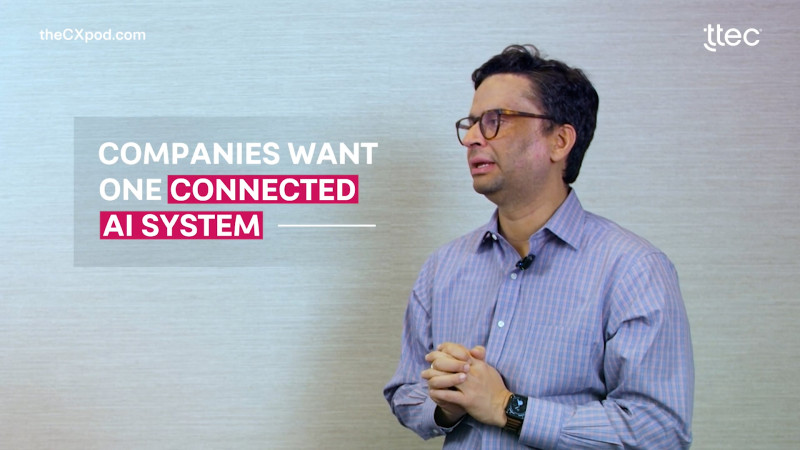
Ashish Nagar: Two or three things. One is, you know, customers realizing that they need one integrated end-to-end system. One of the problems with customer service is that One customer journey is surfaced by a voice agent, then by, let's say, a copilot, AI copilot solution, then let's say an AI QA tool, and then an AI view C2. That's messed up. Four different AIs for one journey.
Liz Glagowski: Yeah.
Ashish Nagar: Customers will realize, nah, I don't want that. We want one connected system, and also one AI across all of them. Like a lot of legacy vendors have four different acquisitions. or something, but there are essentially four different AIs, right? So I think customers will start recognizing, which leads to four different data silos. We are really excited about customers realizing that one system is better.
The other, which, you know, is playing out with Google and OpenAI a little bit, full stack AI. We think full stack AI is the way to like integrating all the way from GPUs to models to data to the apps, right? With an AI trusted in between, that is the stack of the enterprise for the next foreseeable future. put a wrapper, a thin wrapper on top of technology. Those two things I think I'm very excited about because they will show early signs this year, but in my view, they'll be the trends for the next, this whole wave, you know?
Liz Glagowski: Right, right, right. And then I'm asking everyone for their Tech Insights series, if you and I were to talk again a year from now, what kind of things would we be talking about?
Ashish Nagar: I think we would be talking about all the projects which got underway now and the, tremendous ROI. And I know it's like a salesy answer, but the tremendous ROI, most of them were able to deliver and the learnings from some of them, I really feel there will be, it will become really differentiating for brands to have these kind of voice agents be front and center for customers. It'll become really differentiating for brands to have one integrated customer journey. And those, stories are still not prominent, but they will become front and center by next year at large scale.
Liz Glagowski: Yeah. And that will help the overall experience for consumers as well.
Ashish Nagar: That's the biggest thing. For you and I, it makes it, yeah, ultimately we are all consumers of this tech.
Liz Glagowski: Yeah. Excellent. All right. Well, thank you so much, Ashish. Thank you. And I look forward to our conversation next year.
Ashish Nagar: Thank you. Same here.