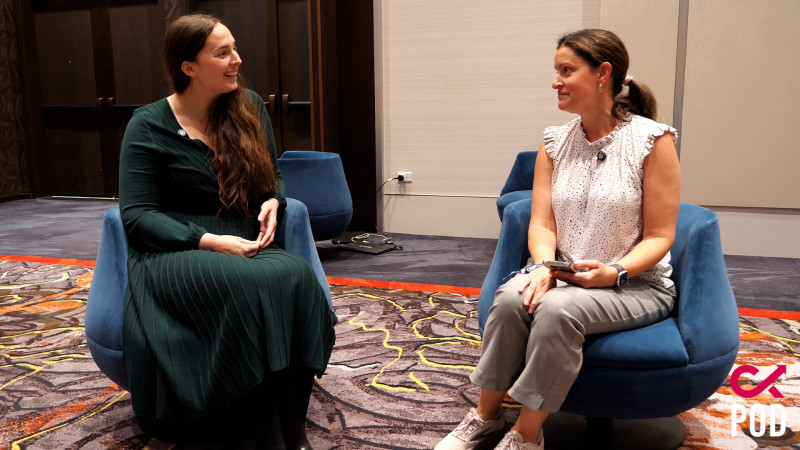
Kyle makes the case that understanding your customer journeys is what delivers maximum value from AI. She also digs into what CMP's latest consumer data is showing: demand for automated and AI-enabled service channels is actually up six percentage points year-over-year.
The episode closes with a sharp conversation about the AI-to-human handoff, and why your knowledgebase health might be the most underrated factor in delivering a seamless customer experience.
Cara Rosner: Welcome to the CX pod. I’m Cara Rosner from Customer Strategist Journal here at CCW in Las Vegas and excited to be chatting with Nicole Kyle, who is Chief Product Officer at CMP, the Custom Contact Research Company. Thanks so much for joining me, Nicole. Nicole Kyle: Thank you for having me. Cara Rosner: So I know that CMP is always assessing what’s going on out in the CX landscape and has its finger on the pulse of all, all the trends. What are a couple of the latest trends that you’re seeing out there when it comes to customer experience? Nicole Kyle: Absolutely. So the first thing we’re seeing is that there’s a real demand for improved customer analytics and insights. We’re hearing a lot from CXOs and heads of customer contact that the key ingredient to, uh, maximizing ROI and their AI investments, delivering a better customer experience, is just getting a better understanding of the customer journey. And that’s not necessarily a new idea, but it’s a lot more urgent right now because so much money is being spent on AI, uh, innovations and solutions. If we’re going to get maximum ROI quickly, we need to be deploying that technology in the right direction. Better customer analytics and insights help you do that. Cara Rosner: Makes sense. It’s so clear even just walking around the expo floor here at CCW, there’s so many technologies. AI is obviously everywhere. There’s so many different vendors to choose from. Do you have any advice for companies that are kind of early in their journey of trying to improve their CX? What are some things that they can get started on to embrace these trends that you’re seeing? And if it all seems a little overwhelming, where can companies start? Nicole Kyle: For sure. So, I think some advice I’d give to companies for early in their AI journey is, uh, start with analytics, right? Get as clear an understanding of your customer journeys as you possibly can. And I say journeys plural because there are so many different types of customers even within a singular customer base, and so many different, uh, ways that they will interact with you. So that’s really critical. The second thing I’ll say is get your, get your data in order, get it centralized, get it clean, be working with those stakeholders at your organizations, IT, RevOps, whoever, um, data about the customers being created in many places throughout the business, not just in customer contact, not just in the call center. Um, so really having that, um, kind of team effort even internally is critical. And the third thing I’ll say is, um, do your, it sounds so obvious to say do your diligence, but, um, the way that we approach our tech demos and the way that we approach our evaluation of providers — um, you know, it’s got to be methodical and, and lead with your requirements. Don’t just chase the, the shiny, the shiny new tool or buzzword, um, you know, agentic solutions for the sake of agentic. There are a lot of use cases where conversational AI or generative AI is more than sufficient. It all depends on the company’s, uh, kind of where they are in their maturity curve and what their requirements are. Cara Rosner: It’s great. Yeah, I’ve been sitting in on a couple of sessions today and yesterday, and it’s interesting to hear the conversations around AI and technology are great, but it’s not gonna help you reach your end goal if you’re embracing technology just for the tech sake. Like you need to be solving a customer pain point. Do you guys find that in your research too? Nicole Kyle: Yeah, we completely agree. We completely agree, and it’s really interesting just speaking to the customer pain points for a moment. Um, something that we’ve seen in some recent, uh, customer and consumer data we’ve, we’ve sifted through is, uh, demand for and preference for, uh, automated service channels or AI enabled service channels is, is growing. It’s actually up 6% points, uh, this year relative to 2023. So, you know, not massive exponential growth, but like a steady increase. Which is something we, we predicted as the technology becomes more pervasive, you know, so many of us are talking to Siri, talking to ChatGPT just in our day to day lives. It’s normal that that becomes a bit more normalized for consumers. So, um, anyway, uh, so demand for self-service experiences is slightly up, um, and it’s up to us to, um, uh, take advantage of that demand, because if the demand is there, the interest is there, but if the experience is bad, what we see in customer data is that customers are much less likely to try self-service, automated service again if they’ve had a bad experience somewhere else relative to live service. So yeah, it’s definitely something to consider. Cara Rosner: Great. Yeah, I’ve also noticed there’s a lot of conversations here at the convention about the handoff and the connection that needs to happen between AI and people. Can you just talk a little bit about that? It seems like, like you’re saying, if self-service doesn’t get the job done, they’re going to be transferred to an agent. They may already be a little annoyed that self-service didn’t meet their needs. So agents now need a whole new set of skills that they maybe didn’t need in the past. Can you just touch on that a little bit? Nicole Kyle: Yes, the handoff between tech and human agents is really, really critical to success. Because in an ideal world, you are delivering a personalized and fast customer experience. Those are the two kind of biggest, biggest drivers of customer success in a self-service experience. So to do that, uh, you need to make sure that that customer is not needing to repeat data, right? They already told the chatbot one thing. Now they have to tell the human agent, and that the handoffs component is, is — it is so important to investigate in your demos with solution providers for Voicebot, for chatbot, um, because if I’m honest, it’s only the most progressive, uh, solution providers who can really deliver on that, um, and you’re something you can do as a company is make sure your knowledge base is in order, because the handoff is a lot smoother when, um, the, the, the knowledge behind the scenes is, is clean. Cara Rosner: Great. So since we’re here at CCW, last question. Um, what topics are piquing your interest while you’re here? What sessions are you checking out? What booths have you seen? Anything interesting? Nicole Kyle: Yeah, uh, so much. So, I, I hate to be, uh, uh, self-promotional, but I’m, I’m really excited about the session CMP is doing. Um, we, of course, uh, we’re talking a lot about tech as a whole conference, but managing the change of an AI augmented workforce is actually one of the most difficult things for executives to get. According to, to our data. So a lot of the people-related and change management sessions are really interesting to me. Um, and of course, we’re also, uh, you know, looking at how consumer and customer preference data is changing. We’re doing a session on, uh, customers’ love for voice channels a little bit later this afternoon. So excited about that one. Cara Rosner: Yeah, it’s interesting. As much as AI and chatbots grow in popularity, I keep hearing the voice channel is still king in a lot of ways. Nicole Kyle: Totally. And some I’ll talk about later is, um, voice channel can have a lot of different permutations. Yes, it can mean a live phone conversation, but it can also be a standard IVR. It could be a conversational IVR. It can be a human-like AI voicebot. Um, so it’s, it’s interesting to look at. Cara Rosner: Great. Well, thank you so much for sharing your insights today. Where can we send people if they want to learn more about CMP? Nicole Kyle: CMPresearch.com. Cara Rosner: Great. Thank you so much and thanks for listening to CX pod.
TRANSCRIPT: