Few industries are as personal as healthcare – especially when it comes to claims processing, where people’s health and financials intersect. Relationships matter in this work yet, too often, inefficient processes damage the very relationships that healthcare providers and payers work so hard to build.
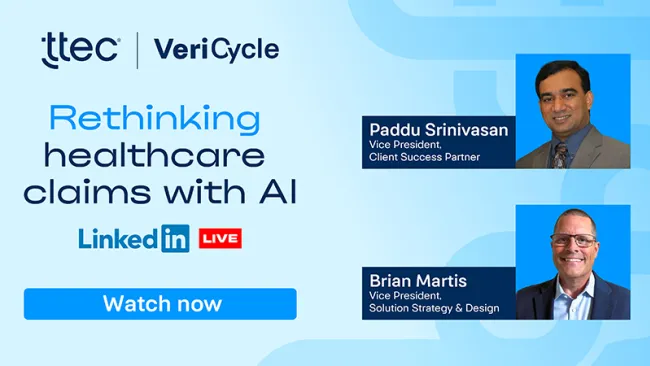
AI can help. In a recent webinar, “An AI remedy for a frustrating healthcare claims lifecycle,” TTEC experts explored how AI-enabled solutions can reduce friction across the claims system and help transform a historically reactive process into a proactive one that builds satisfaction and loyalty.
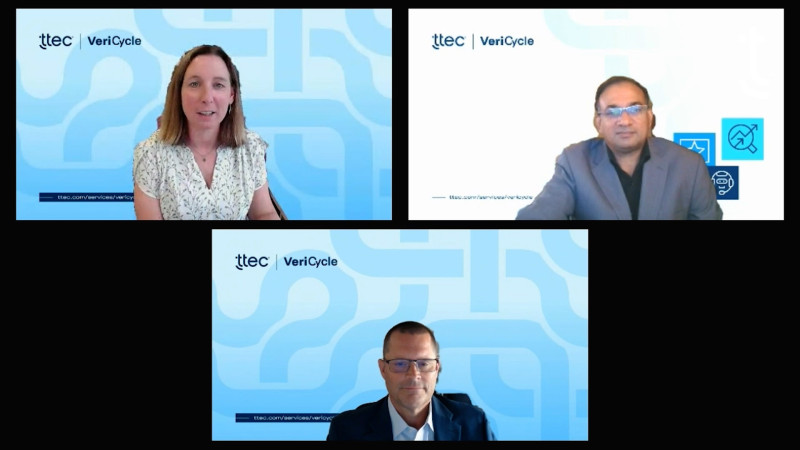
Paddu Srinivasan, TTEC’s healthcare vice president and client success partner; and Brian Martis, TTEC vice president of solutions, strategy, and design, discussed the challenges facing payers and providers in an evolving claims landscape – and how the right balance of AI and humans can elevate patient and member experience.
Why claims management needs to catch up
One big hurdle in claims management is that processes haven’t kept up with the rate of change, Srinivasan said.
“Healthcare has become dramatically more complex while many claims management processes are still operating on frameworks that are designed for a much simpler environment,” he said. “The real issue is that many organizations are still relying on fragmented systems and manual touchpoints in a healthcare ecosystem that’s becoming increasingly complex.”
Providers must navigate increasingly complex claims coding systems and growing documentation demands, he said, and payers face constant pressure to handle claims as quickly as possible while still ensuring claims’ authenticity. And all this is happening in a highly regulated industry where compliance is paramount.
The claims process is a complex one, he said, and just one hiccup – a missing piece of documentation or coding error, for instance – can derail a resolution for days or weeks, leading to a denial or delayed reimbursement. And that incurs additional operating costs for payers and providers.
An AI copilot makes for a more efficient claims system
This is where AI-powered claims cycle management platforms can help, said Martis.
The traditionally claims process is very manual: teams need to spend a lot of time verifying eligibility, validating coding, researching claims status, and processing remittances. Doing so requires toggling among multiple systems, too.
But AI-powered platforms, like TTEC VeriCycle, use machine learning to verify eligibility and flag coding issues before a claim is even submitted, Martis said.
“They’re fundamentally changing how healthcare organizations operate,” he said. The results? Fewer errors, denials, and escalations; faster reimbursements; and happier patients and members.
The technology is poised to have a huge impact on the workforce, he added. Instead of spending large portions of their days on repetitive, mundane tasks, agents can relegate those to-dos to AI and focus on the complex interactions where they add more value.
“AI has become a copilot, essentially, that continually surfaces those insights, gives those employees or agents next best actions, and then helps that team work more efficiently,” he said.
The claims process grows far more proactive
Organizations usually only look at claims denials after they’ve already happened, but AI is empowering teams to become much less reactive.
“By the time a denial occurs, revenue has already been delayed,” Srinivasan said. Then that claim has to be investigated and perhaps appealed. “That’s a lot of effort and spend after the problem has already happened.”
Modern AI tools make it possible to foresee some denials before they happen. In the past, denial prevention was hard because teams didn’t have the bandwidth to review every claim with the same level of scrutiny, Martis said. But AI can evaluate every claim across hundreds or thousands of payer policies with the equal rigor.
“The platform isn’t waiting for a denial to teach us something,” he said. “It’s identifying risks while there’s still time to correct it.”
In the AI era, an agent can open a claim where the eligibility status has already been assessed and documentation gaps have already been identified for them. This leads to less rework across the entire operation and, ultimately, fewer appeals, he said.
Smarter claims start with AI and human judgement
For all of AI’s potential, healthcare will always be a people-centered business, Srinivasan said. Humans bring judgement and empathy to the claims process that technology can’t match.
The most successful organizations aren’t using AI to replace people; they’re using it to put more, better information at agents’ fingertips so they can work smarter and deliver better customer outcomes, he said.
Humans should still be responsible for decisions and approvals and still own the outcomes, added Martis. AI just gives them more intelligence to inform those decisions.
“In this model, AI is becoming a digital teammate,” he said.
To hear the entire conversation, watch the webinar on demand.