For retail CX leaders, the pressure is acute. Shoppers expect fast, frictionless, personalized service across every channel, and AI was supposed to be the key to delivering it at lower cost. The industry invested — often heavily — bolting new tools onto operations built for an earlier era.
Now the AI receipts are coming in, and they don't match the pitch.
And retailers face an additional challenge: AI agents are increasingly making purchase decisions on customers' behalf (whether retailers are ready or not) as major retailers partner with AI platforms to let agents discover and buy products directly.
Retailers are learning that AI doesn't create CX problems, but it does expose them. The silos, disconnected touchpoints, and confusing journeys that used to hide behind a human associate are now visible the moment AI sits at the front line.
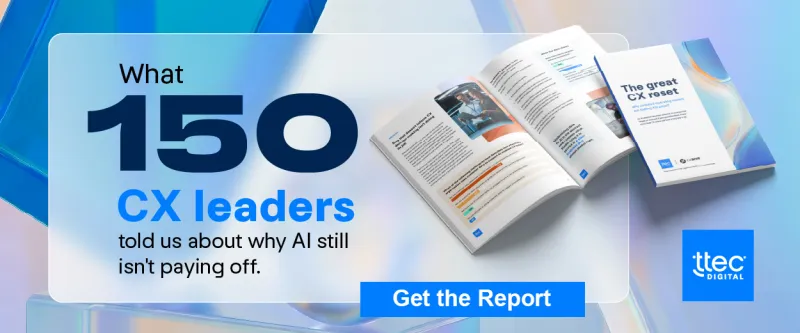
A new research study from TTEC Digital and CX Dive, The Great CX Reset, asked 150 customer experience (CX), contact center, and IT leaders: has AI actually reduced your costs? Not a single respondent reported measurable cost reductions from AI, whether measured against cost to serve, operating costs, or technology costs. Nearly two-thirds said the opposite had happened; AI adoption had increased their costs. The very thing the investment case was built to deliver hasn't shown up on the balance sheet.
Roughly 10% of respondents came from retail and wholesale brands, where margin pressure is relentless and every tool in the stack has to earn its place. So, what went wrong? That question sits at the heart of the report, which digs into the gap between what CX leaders expected from AI and what they're actually seeing, and what to do about it.
The problem isn't the technology; it’s the operating model
The report highlights that AI isn't failing because the technology is immature. It's failing because the organizations deploying it haven't changed fast enough to keep pace. Just 1% of executives describe their operating model as highly adaptive and built for continuous change.
CX strategies have evolved, but the structures beneath them — the teams, workflows, and governance — haven't. Companies have effectively bolted advanced AI onto rigid, pre-AI operating models that were never designed for cross-platform coordination, scalable AI skillsets, or the governance needed to build trust in AI outcomes.
That mismatch showed up everywhere researchers looked.
The observability gap
There’s a difference between what leaders think is happening in the contact center and what's actually happening. Most CX leaders, or 75%, say their technology stack is "well connected," which sounds reassuring until a follow-up question is asked.
When pressed on whether they can confidently say where AI is actually being used across the customer journey, only 43% answered yes. Nearly six in ten organizations run seven or more distinct platforms, and coordinating AI governance across that sprawl is a structural challenge most teams aren't equipped to manage.
For retailers, that sprawl is already familiar. The study found that retail brands use an average of four to six tools in their tech stack, a narrower set than the cross-industry average but still enough to create real coordination challenges when AI is layered on top.
That gap — feeling connected but lacking real visibility — is exactly where ungoverned automation takes root. Redundant tools multiply and decisions get made in the dark. The stakes are high, the report found: teams that do know where AI is being used across the journey are 52% more likely to believe it will deliver. Observability isn't just hygiene; it's a performance multiplier.
Confident on the surface, stretched underneath
If there's a theme running through the findings, it's the gap between confidence and capability. While 90% of leaders feel confident in their ability to deploy AI, 0% report having zero internal AI skills gaps. Every organization surveyed, regardless of size or maturity, has identified at least one skills shortfall.
The research found that retail/hospitality organizations had the lowest reported access to internal AI and automation resources in house, at just 18% (every other industry surveyed had 21% or higher), which juxtaposes with how confident many brands feel when it comes to implementing AI.
When it comes to governing AI responsibly, only 29% of all brands surveyed apply a formal, cross-functional governance process consistently. Most apply policies inconsistently, leaving themselves exposed to unmanaged risk.
The strongest teams, the report finds, have found a workable middle path: keeping strategy, prioritization, and governance in-house, then bringing in specialized AI expertise to accelerate execution.
According to the report, retail/hospitality respondents are the most dependent on external resources or managed services to fill gaps related to standing up AI initiatives. When asked, 53% of respondents in the industry said they rely on external resources, compared with 35% across all respondents. Other industries reported having a wider range of solutions to this problem, such as using a mix of internal and external resources or upskilling internal talent.
This presents a challenge for retailers: when AI is outsourced, internal teams might not be bought into how it gets used and who owns outcomes.
Where leaders are pointing next
When asked where they plan to focus resources in 2027, CX leaders pointed to three priorities that map to the gaps the research uncovered:
- Modernizing data foundations (43%): fixing reporting tools, governance, and real-time access, the infrastructure that makes everything else possible.
- Improving cross-functional coordination (41%): breaking down legacy silos across operations, IT, data, and compliance.
- Connecting CX to business outcomes (38%): building measurement frameworks that tie CX performance to the balance sheet, making the ROI case visible rather than assumed.
It’s time for a CX reset
The organizations that recognize the gap between AI investment and AI return, and that work to close it, will be the ones that finally turn their CX spend into measurable impact. The ones that don't will keep spending more for the same disappointing results.
The Great CX Reset lays out the full picture, with breakdowns by leadership role and industry, a clear-eyed look at where AI initiatives are stalling, and a closer look at what the strongest teams are doing differently. Download it here.